penang vegetable curry

When I was new to Thai food I was a Pad Thai girl all the way.  Pad Thai seems to be the gateway food for many who are new to Thai cuisine, though I eventually did venture away from the noodle dish and experimented with Massaman curry and satay and various peanut-based curries.  Lately I’ve been really into Penang curry.

I’m not so well-versed in Thai food as to be able to tell you what makes Penang curry different from other curries, I just know that I like it and also that a local Asian grocer conveniently carries Penang curry paste.  Score.

I found a recipe for a simple vegetable curry to use as a guide and went from there.  The recipe called for sweet potatoes (love), cauliflower, and chickpeas (which I had cooked up myself from dried beans and stored in my freezer for later use a few months back).

I wanted to add a little more color to the curry so threw some frozen peas into the mix.

A little tip that I sort of feel like a genius for thinking up, though by no means do I think that I am the first one to have this thought: the recipe called for coconut milk and a cup of water so I emptied my can of coconut milk and then filled the can up with water and added that to the pot.  It made broth richer by getting a little more coconut milk in there and also cleaned out the can for recycling at the same time: two birds, one stone.  So simple, and yet I’d never thought to do this before.
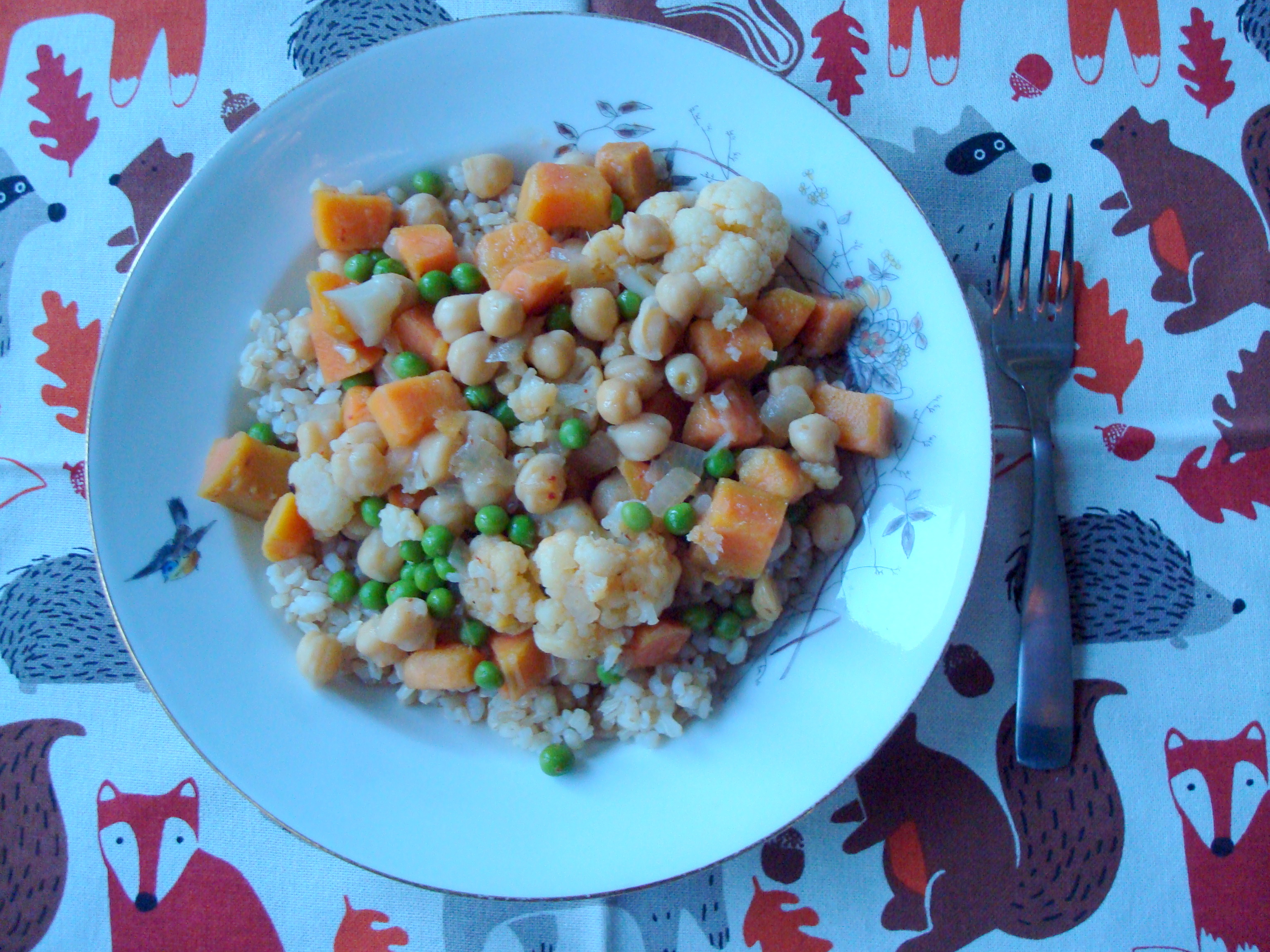
The resulting curry tasted pretty much exactly like the Penang curry I often get at a local Thai restaurant so on nights I don’t feel like making the half hour drive for carry-out I can recreate it myself at home.  It would be especially excellent with a little Thai iced tea.
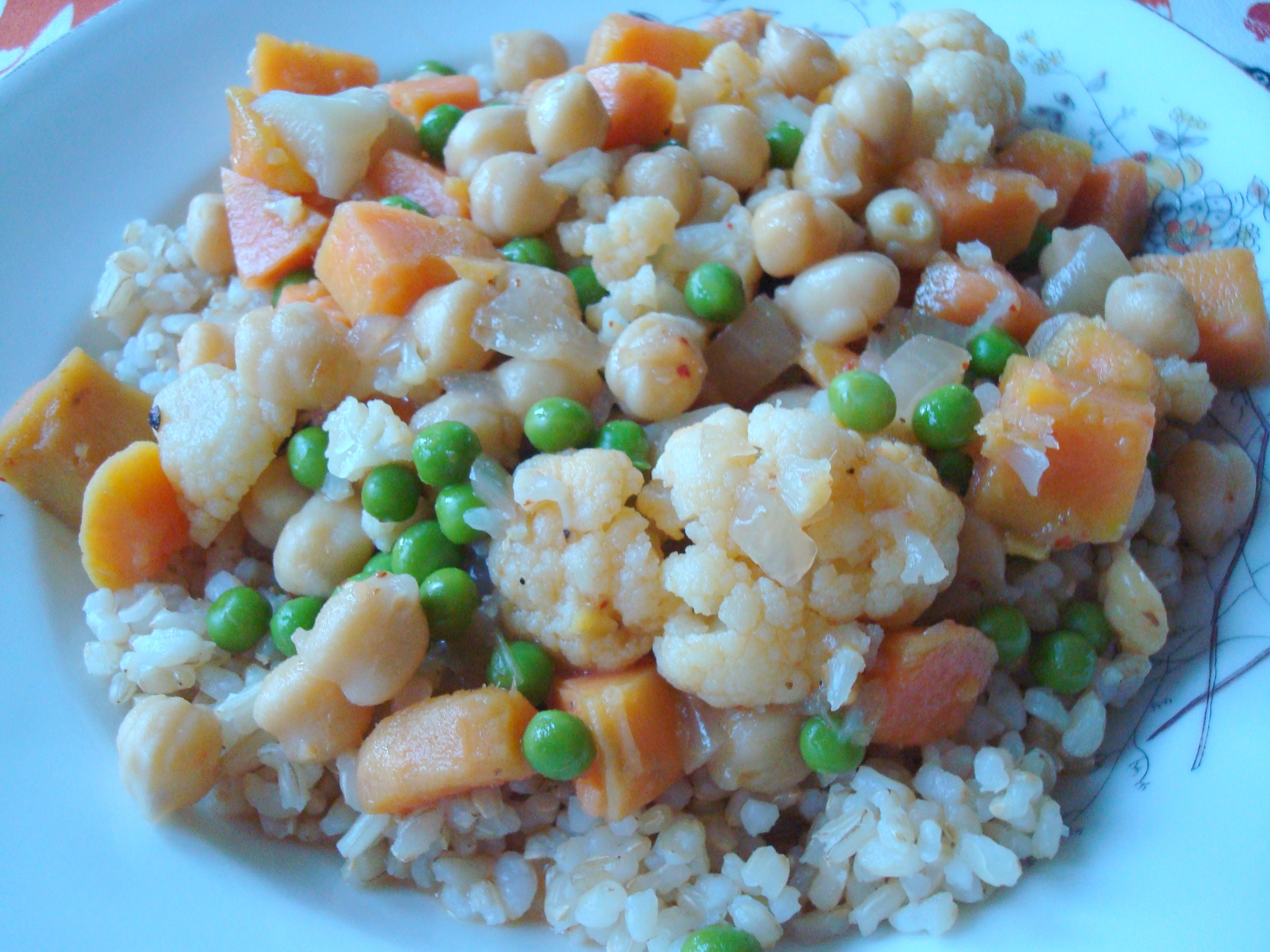
Penang Vegetable Curry (loosely adapted from “Simple Vegetable Curry” from Everyday Food magazine)

  • 1 tablespoon olive oil
  • 1 medium yellow onion, diced small
  • coarse salt and ground pepper
  • 2 tablespoons Penang curry paste
  • 13.5 oz. can of unsweetened coconut milk
  • 1 sweet potato (about  3/4 pound), peeled and cut into 1-inch pieces
  • 1 small cauliflower, cut into florets
  • 1 can (15.5 ounces) chickpeas, rinsed and drained
  • 1/2 bag of frozen peas

In a large Dutch oven or heavy pot, heat oil over medium-high heat. Add onion and cook, stirring often, until soft, 3 minutes. Add curry paste and stir until fragrant, about 1 minute. Stir in coconut milk and 1 cup water and bring to a boil. Add sweet potato and cauliflower and season with salt and pepper. Reduce heat to medium, cover, and simmer until vegetables are tender, 10 to 15 minutes.

Stir chickpeas into curry and increase heat to high. Simmer rapidly until liquid reduces slightly, 2 minutes. Serve curry over rice.

sweet potato fries

This is going to feel like a cheat post and it kind of is.  There are only two photos and the recipe is one that I have memorized I make it so much.  I’m not sure if there even was a recipe originally, but I suppose those are the best kind.

Much like kale chips I make these when I feel like I want healthy versions of junk food.  Which is often.

I like to peel my sweet potatoes but you could certainly leave the peels on yours if you’re into that.  I toss the peeled sliced sweet potato chunks with olive oil, salt, pepper, and cumin, though you could shake it up and change out the cumin for curry powder and that would be awesome too.  Shake it up a bit.

These fries are healthy because they aren’t actually fried, they’re baked.  Genius.  Sometimes I eat them with honey, sometimes with ketchup, and sometimes plain– just depends on what kind of mood I’m in.  You could even get fancy and whip up an aioli to serve them with.  Go forth and enjoy!

Baked Sweet Potato Fries

  • Sweet potatoes, peeled and cut into desired fry shape (I like to cut them thick like classic steak fries)
  • Olive oil
  • Salt
  • Pepper
  • Cumin or curry

Preheat oven to 425 degrees F.  Toss sweet potato fries with a little olive oil until lightly coated.  Sprinkle fries with salt, pepper, and cumin or curry.  Bake for 30 minutes, shaking pan several times to bake fries evenly.  Serve with ketchup or honey, if desired.

just beet it

I’m ashamed to say that I once shied away from beets.  Their strange texture, earthy smell, and vibrant color used to totally freak me out.  I’m very glad to say I got over that and realized how wonderful they are and now grate them raw into salads and juice them on a regular basis.  A coworker of mine makes the most excellent pickled beets that someday I plan to learn how to replicate.  But today we roast them.

A friend of mine teases me because I like everything roasted.  Almonds, flax seeds, sweet potatoes, garlic.  The list goes on.  So when I found a recipe for roasted beet and potato borscht I was totally intrigued.  Borscht is a beet-based soup and it has been something I have always been curious about but never wanted to try because I wasn’t sure I could eat a whole bowl of soup dedicated to the boldly-colored, earthy-smelling vegetable.  If the beet were first roasted, however, I think it could be a thing of beauty.

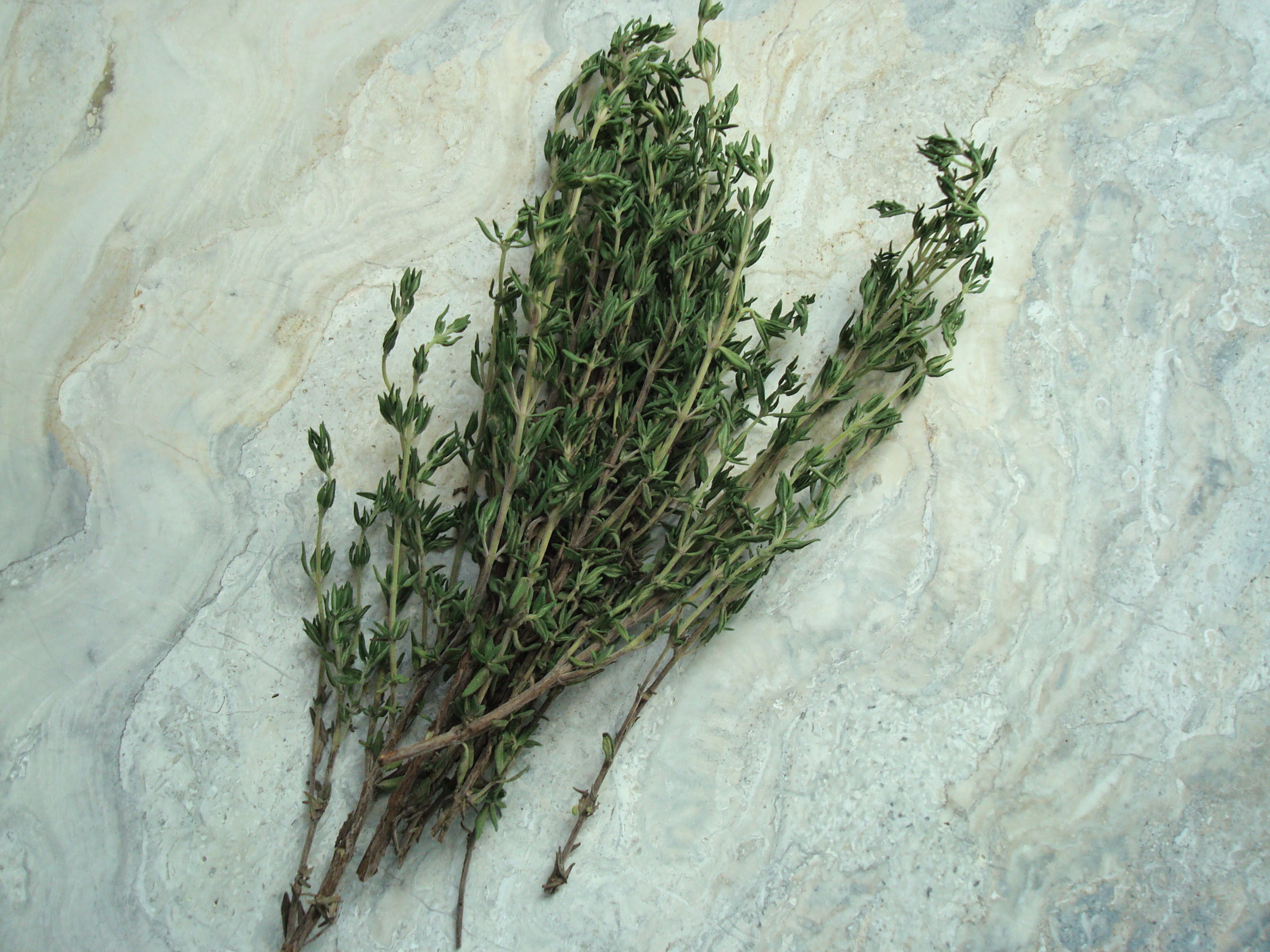
The recipe couldn’t be simpler: you peel and chop up some beets and potatoes and throw them in with chopped shallots (I didn’t have any on hand so used a yellow onion which worked out just fine) into a roasting pan, toss with olive oil, salt, and freshly ground black pepper and then add a couple of twigs of thyme and roast them all in the oven for about 45 minutes.

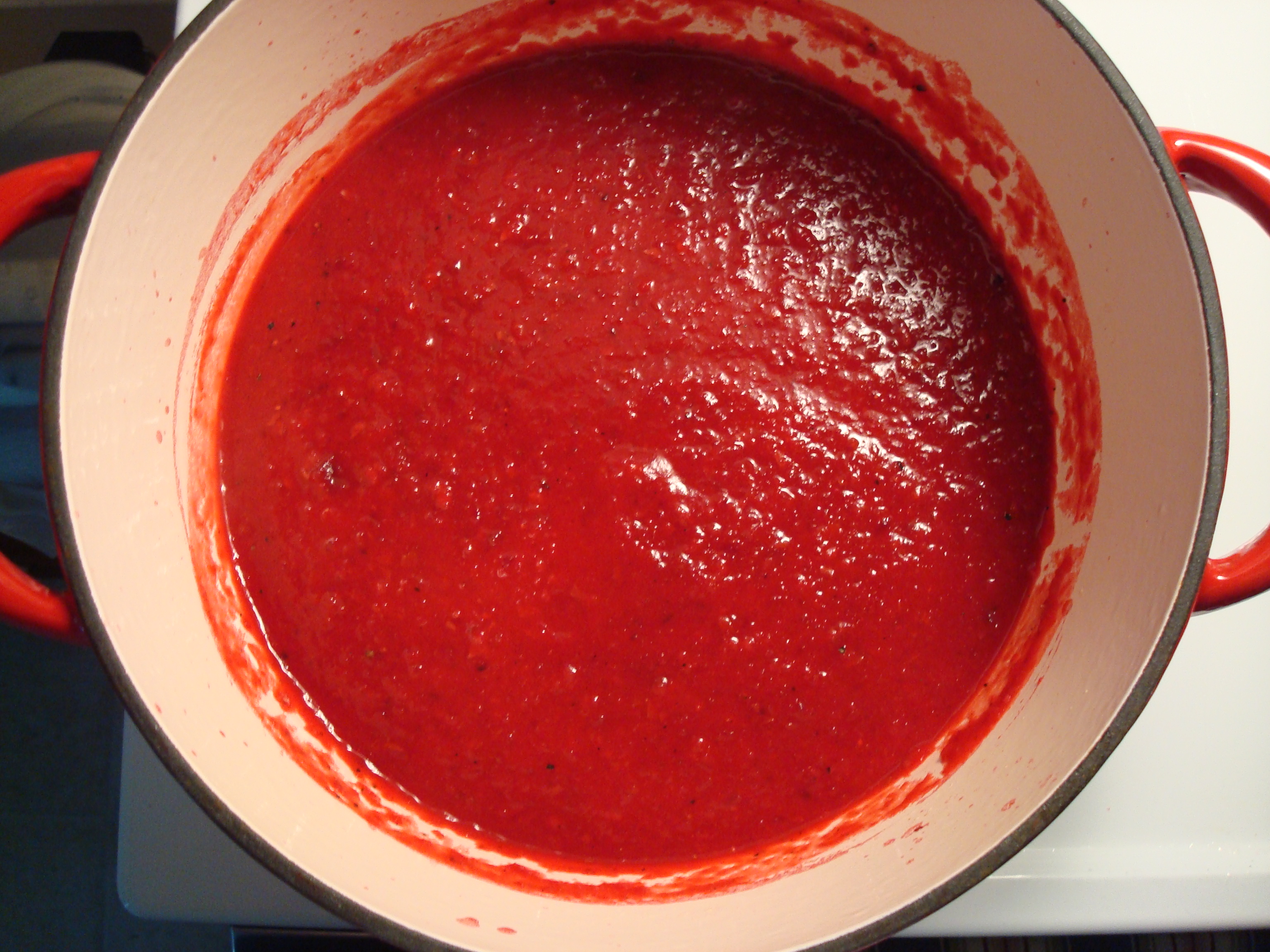
Once the roasting is done, discard the thyme, and add the vegetables to a large pot with 5 cups of chicken broth or water and bring to a simmer.  Then you mash the vegetables with the back of a wooden spoon or potato masher or use an immersion blender and voila.  Add a splash of red wine vinegar and top with sour cream and scallions or parsley if you so desire.  I skipped the toppings and it was delicious.  Roasting is the way forward.

Roasted Beet and Potato Borscht (from Everyday Food magazine, also found at www.marthastewart.com)

  • 2 pounds red beets, scrubbed, peeled, and diced medium
  • 1 pound russet potatoes, peeled and diced medium
  • 2 shallots, coarsely chopped
  • 3 to 5 sprigs thyme
  • 2 tablespoons extra-virgin olive oil
  • Coarse salt and ground pepper
  • 5 cups low-sodium chicken broth or water
  • 1 tablespoon red-wine vinegar
  • Sour cream, (optional)
  • Chopped fresh parsley (optional)
  • Thinly sliced scallion greens (optional)

Preheat oven to 400 degrees. In a roasting pan or rimmed baking sheet, toss together beets, potatoes, shallots, thyme, and olive oil; season with salt and pepper. Arrange in a single layer and roast until beets and potatoes are cooked through, about 45 minutes.

Discard thyme. Add vegetables to a medium pot, along with broth. Bring to a simmer over medium-high. With a potato masher or back of a wooden spoon, mash some vegetables until soup is thick and chunky. (I made quick work of it by using my immersion blender.)  Stir in vinegar and season to taste with salt and pepper. To serve, top with sour cream, parsley, and scallion greens, if desired.

o is for okra

Normally, I’m a list person.  I don’t go anywhere without a list, especially not to a place that almost requires a list like a grocery store.  That would be like leaving the house without my cellphone.  You know what I mean.  Leaving your house without your cellphone is the new leaving your house without clothes on.  You feel vulnerable and lost without it these days.

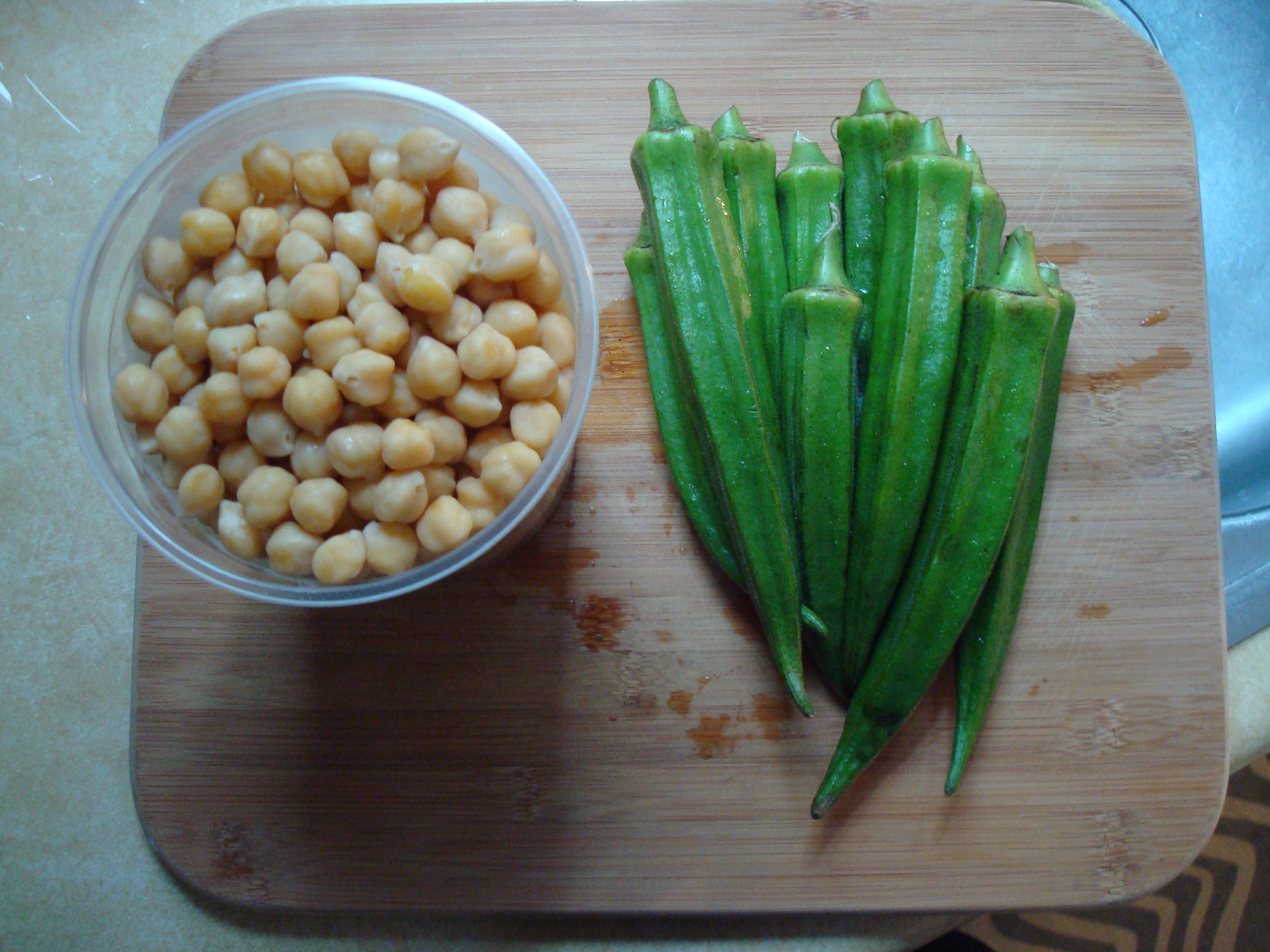
So Saturday morning I did something radical: I threw caution to the wind and decided to go to the farmer’s market sans list.  It was wild.  I wound up picking up a few predictable things: raspberries, green beans, kale, but also came home with a few surprises: namely, okra.  I have eaten it in restaurants before but if the farmer’s had not labeled the okra in their stands I would not have recognized it in its whole form.  But what the heck, I could find something great to do with it.

I did a little research on my iPhone and the first recipe I came across was the one I decided to go for: curried okra with chickpeas and tomatoes.  This was perfect because a) I love curry, and b) I had both chickpeas and a can of tomatoes that needed to be used up in my pantry.  One thing that I wish I had known beforehand was that it is better to buy small okra.  My greedy eyes thought that bigger would be better so I bought okra that was 5 to 6 inches in length when apparently 2 to 3 inches is better.  I definitely could have fit more okra into my pot if they weren’t so big.  But nevermind, they still tasted great and I’m totally psyched about cooking with okra again in the future.  Sometimes it’s a very good thing to leave your lists at home!

Curried Okra with Chickpeas and Tomatoes (recipe found at www.epicurious.com)

  •   1 ¼ lb small fresh okra, left untrimmed, or 2 (10-oz) packages frozen whole okra (not thawed)
  •   1 ½ tablespoons vegetable oil
  •   1 medium onion, chopped
  •   2 garlic cloves, finely chopped
  •   4 teaspoons finely chopped peeled fresh ginger
  •   2 teaspoons curry powder
  •   1 (14- to 15-oz) can whole tomatoes in juice, tomatoes chopped, reserving juice
  •   1 (19-oz) can chickpeas, drained and rinsed (2 cups)
  •   2/3 cup water
  •   ¾ teaspoon salt
  •   ¼ teaspoon black pepper

If using fresh okra, trim, leaving tops intact, being careful not to cut into pods.

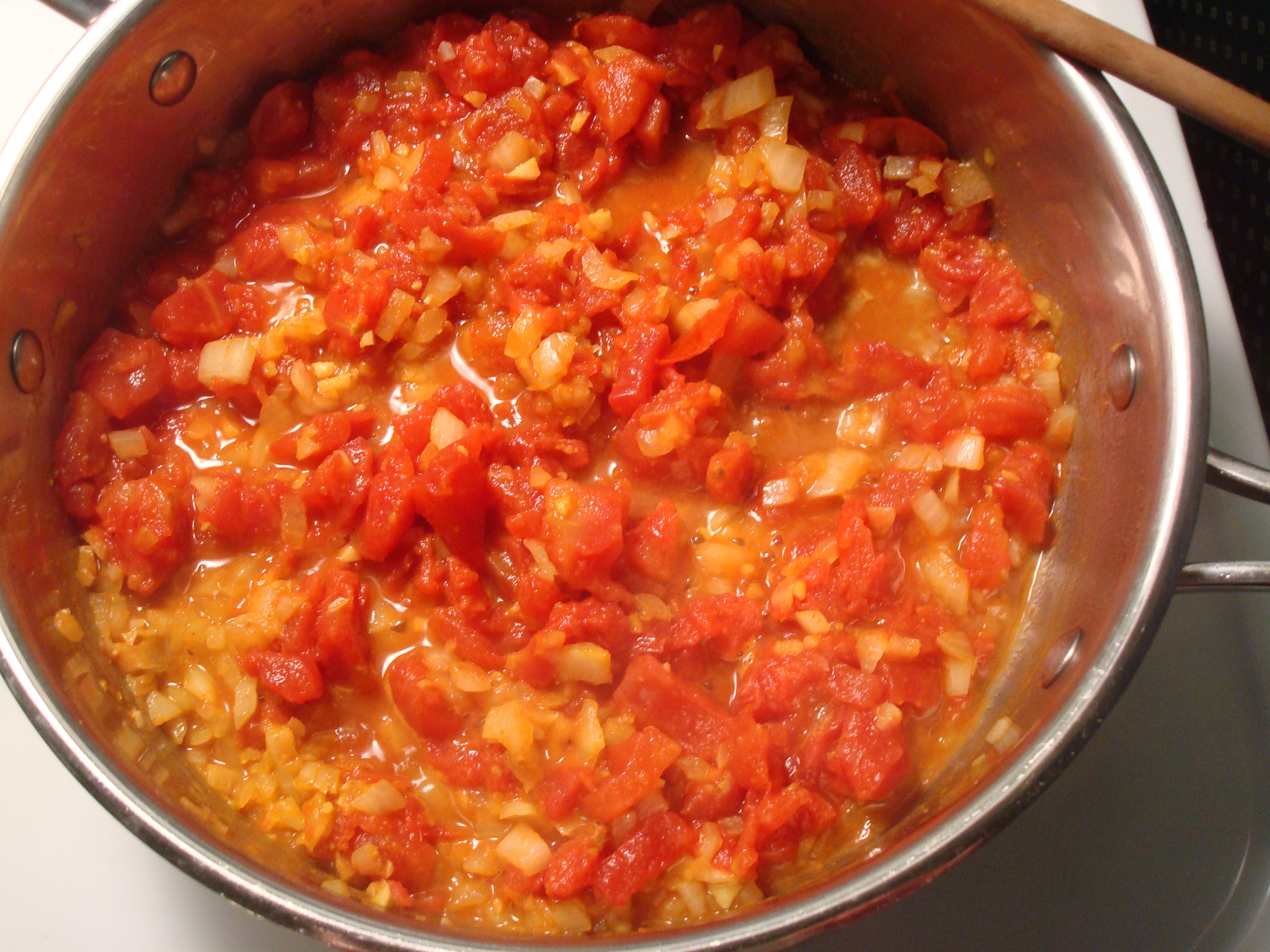
Heat oil in a 12-inch heavy skillet over moderately high heat until hot but not smoking, then sauté onion and garlic with ginger and curry powder, stirring, 2 minutes. Add tomatoes with their juice, chickpeas, and water and boil, uncovered, stirring occasionally, 3 minutes. Stir in okra, salt, and pepper and simmer, covered, stirring occasionally, until okra is tender, about 10 minutes.

Serve over rice or quinoa.

a dish that will keep the vampires at bay

After discovering last year that I love kale I wanted to find another way to prepare it because even though I could eat kale chips until the cows come home I thought it might be nice to diversify my kale repertoire.

This preparation is equally as simple and slightly more flavorful with the addition of not one, but two different cuts of garlic (sliced and minced) and red pepper flakes.  You can go crazy with the garlic– the recipe suggests 5 to 6 cloves, it just depends on what your plans for the rest of the evening are.  You for sure will be breathing it all night if you go full on with the garlic but on the bright side you will be warding off colds and vampires in equal measure.  Not bad things to do.

The kale is so tender and well-flavored that I could eat a giant bowl of it, and in fact did.  It makes a great side along with fish or pork or chicken or really any old thing you want to pair it with.  Yeah kale!

Kale with Double Garlic (from “How to Cook Everything” by Mark Bittman)

  • 1 pound kale, collards, or broccoli raab, with stems under ¼” thick, well washed
  • ¼ cup olive oil
  • ¼ cup thinly sliced garlic, about 5 or 6 cloves, plus 1 teaspoon minced garlic, or more to taste
  • ½ teaspoon crushed red pepper flakes, or to taste
  • Salt and freshly ground black pepper to taste
  • ½ cup chicken, beef, or vegetable stock, or water
  • Lemon wedges

Coarsely chop the stems and leaves of the kale.

Place the olive oil in a large, deep saucepan.  Add the sliced garlic, pepper flakes, salt, and black pepper and cook over medium-high heat for about 1 minute.

Add the kale and the stock or water.  Cover and cook over medium-high heat for approximately 5 minutes, or until the greens are wilted and just tender but still a little firm.

Uncover the greens and continue to cook, stirring, over medium-high heat, until the liquid has all but evaporated and the greens are quite tender.  Taste for seasoning and add red or black pepper and salt as needed; add the remaining minced garlic, cook for 1 minute more, and serve, with lemon wedges.