the right stuff

You could say that Thanksgiving is all about the turkey but let’s be real here: it’s really all about the stuffing.  Hands down stuffing is the best part of the whole meal and definitely everyone’s favorite leftover.  (Right?  I’m not alone here, am I?)

I used to be more of purist when it came to stuffing and always made the traditional kind with breadcrumbs, onions, celery, sage, etc. and then I branched out and did a cornbread version.  Last year I got real crazy and added sausage, apples, and dried currants.  Somebody stop me!

If you’ve been a reader of Baxter and Main for even a short while you have probably noticed my affinity for all things bacon so when I saw a recipe for stuffing with pancetta (which is essentially Italian bacon) I could not pass it up.  The fact that it also included chestnuts which is an ingredient I have only begun to experiment with was just icing on the cake.

This stuffing also has prunes which add a nice sweetness and probably help balance out some of the not-so-good-for-you ingredients (see image above of pancetta frying in butter…)
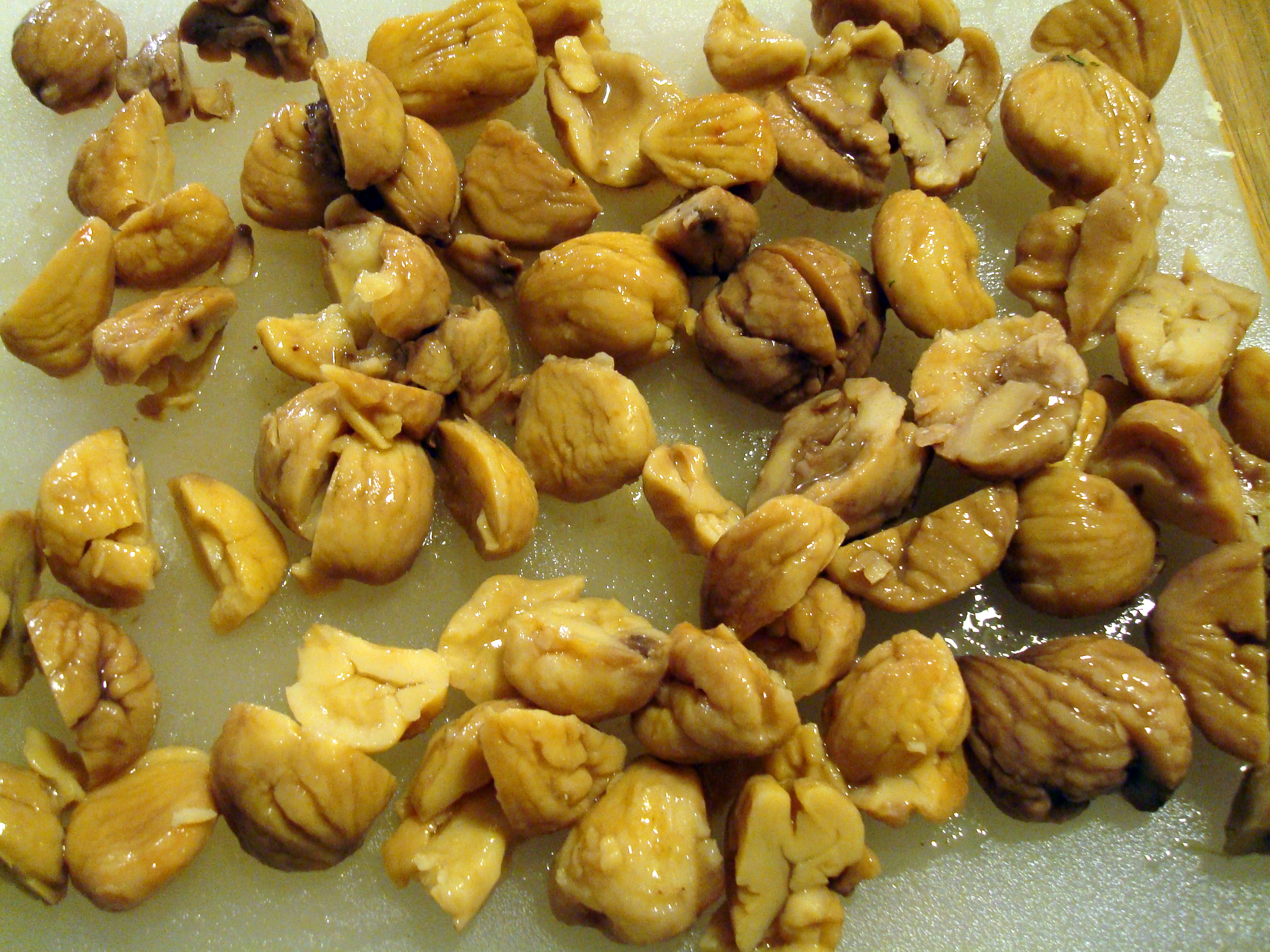
The recipe called for canned chestnuts which were not so easy to find in Madison, Wisconsin.  I tried three different grocery stores before winding up at the LARGEST grocery store I have ever seen in my life (it rivals a suburban Wal-Mart in square footage with maybe a Kmart thrown in for good measure) where I spent a good half hour seeking them out.  Would they be near canned vegetables?  No.  With nuts?  Naw.  In the ethnic food section?  Nope, weren’t there either.  Turns out they get shelved next to the canned pie filling.  Wha-wha-what?  Yeah, that’s what I said.

However, the long search for the canned chestnuts was well worth it as the stuffing was delish.  A very strong contender for this year’s Thanksgiving meal, indeed.

Chestnut, Prune, and Pancetta Stuffing (found at www.epicurious.com)

Yield: Serves 12
Active Time: 45 min
Total Time: 2 hr

  • 1 (1 1/2-lb) sourdough loaf, cut into 1/3-inch dice (18 cups)
  • 1 lb coarsely chopped pancetta slices (about 3 cups)
  • 1 stick (1/2 cup) unsalted butter, cut into tablespoons
  • 3 cups chopped celery (5 to 6 ribs)
  • 4 cups chopped onions (2 large)
  • 2 tablespoons chopped fresh sage
  • 1 1/2 teaspoons salt
  • 1/2 teaspoon black pepper
  • 3 (7- to 8-oz) jars peeled cooked whole chestnuts, halved (4 cups)
  • 3/4 lb pitted prunes (2 cups), quartered
  • 5 cups turkey stock , heated to liquefy, or reduced-sodium chicken broth (40 fl oz)
  • 4 large eggs, lightly beaten

Put oven rack in upper third of oven and preheat oven to 400°F.

Scatter bread in a single layer in 2 large shallow baking pans (17 by 12 inches) and toast, stirring once or twice and switching position of pans halfway through baking, until golden and dry, about 15 minutes. Transfer to a very large bowl.

Cook pancetta in a 12-inch heavy skillet over moderate heat, stirring occasionally, until browned, 12 to 15 minutes. Add butter and heat until melted, then add celery and onions and cook, stirring occasionally, until softened, about 12 minutes. Stir in sage, salt, and pepper and cook 1 minute.  Add pancetta mixture along with chestnuts and prunes to bowl containing bread. Whisk together stock and eggs, then stir into bread mixture until combined well. Transfer to baking dish (stuffing will mound above dish).

Bake, loosely covered with a buttered sheet of foil (buttered side down) 30 minutes, then remove foil and bake until top is browned, 10 to 15 minutes more.

Cooks’ notes:
•Stuffing, without stock-and-egg mixture, can be assembled (but not baked) 1 day ahead and chilled, covered. Stir in stock mixture, then proceed with recipe.
•Stuffing can be baked 6 hours ahead and cooled completely, uncovered, then chilled, loosely covered. Reheat, covered, in a preheated 400°F oven until hot, about 30 minutes.

taking stock

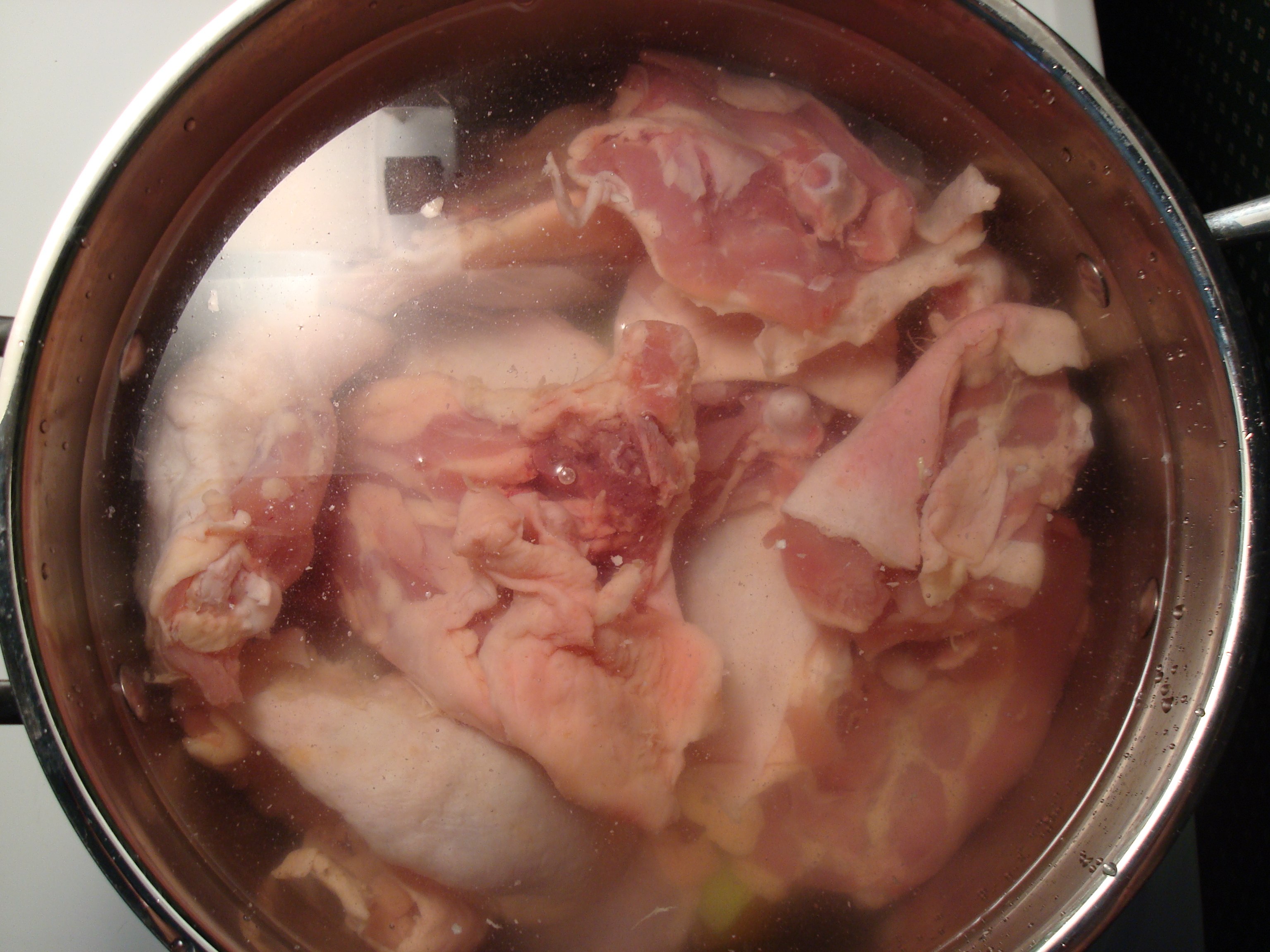
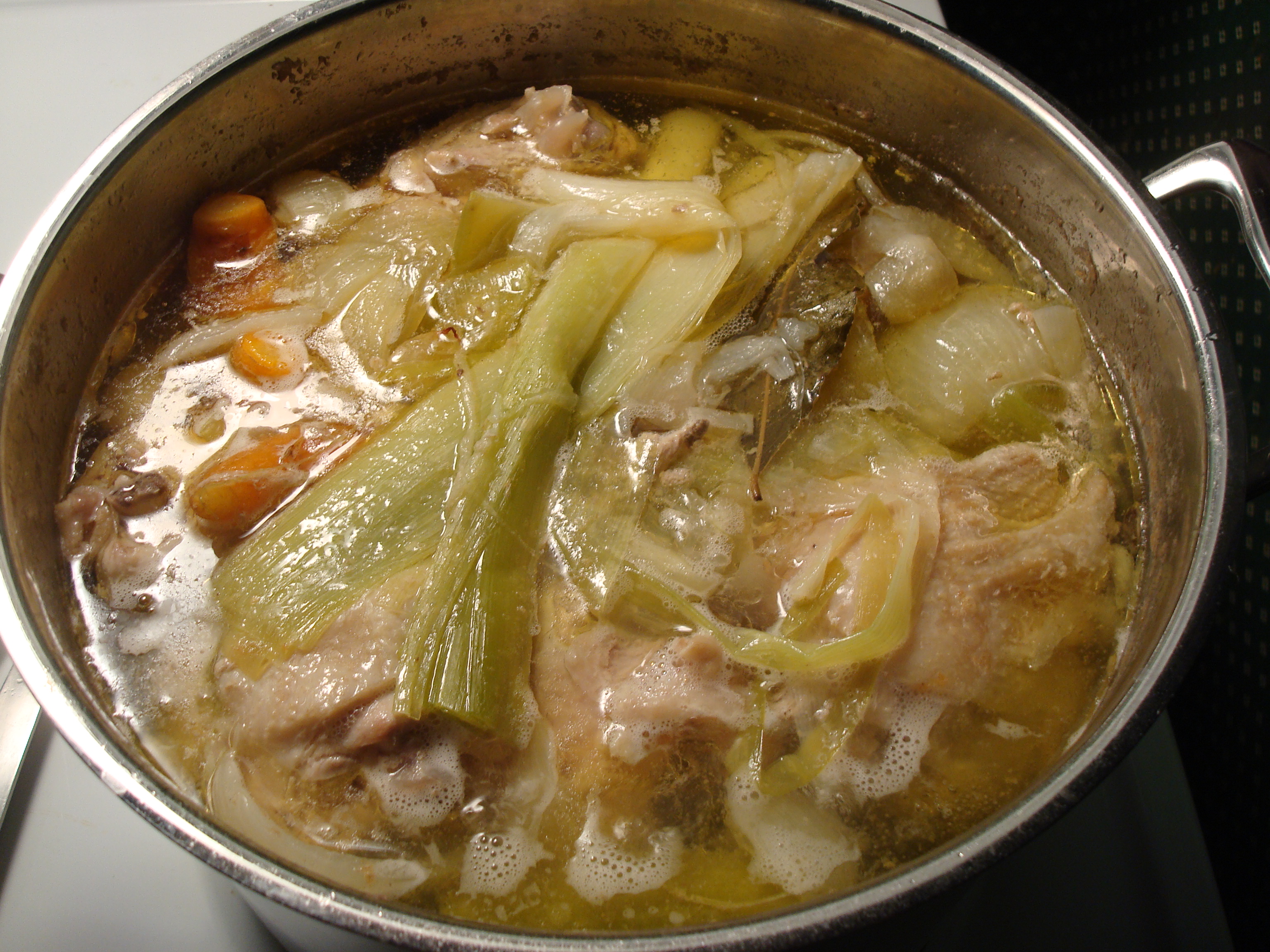
I’d heard that making your own chicken stock was simple and that it tastes infinitely better than the stuff you buy in the stuff you buy in the grocery store but I just thought, who has the time?  Turns out I do.  On Saturday night (don’t get jealous now!) I stayed in and cleaned my apartment from top to bottom and made chicken stock at the same time.

It’s as simple as chopping up a few vegetables and throwing them into a pot with a few herbs, a whole bunch of chicken, and some water.  (I did some recipe research and it seems like most recommend using chicken bones, backs, or thighs so that you are not wasting meat.)  You bring all of that to a boil and then let it simmer for a couple of hours.

My apartment smelled wonderful as I cleaned and the stock was done before I knew it.  Straining was simple and Martha’s suggestion of putting the strained stock into the fridge overnight so that the fat rises to the top and can then be easily scooped off is a great one.  The next morning I skimmed off the fat and froze the stock in 4-cup batches.  It will be great to have on hand for soups and of course for Thanksgiving.  Sayonara to the over-salted boxed kind from the grocery store!   Our relationship was convenient while it lasted, but I’m afraid I won’t be needing your services any longer…

Chicken Stock (adapted slightly from recipe found at www.marthastewart.com)

Yield: Makes 1 1/2 quarts

  • 4 pounds chicken thighs
  • 1 medium onion peeled and quartered
  • 5 shallots, peeled
  • 1 large carrot cut into thirds
  • 2 celery stalks cut into thirds
  • 2 large or 4 small leeks cut in half lengthwise and well washed
  • 2 bay leaves
  • 12 whole black peppercorns

Place all the ingredients into an 8-quart stock pot and cover with cold water.  Bring to a boil over high heat.

As the stock approaches a boil, remove any impurities that rise to the top by skimming with a ladle. Reduce the heat and simmer the stock for 3 to 4 hours, continuing to skim impurities from time to time while the stock cooks. Taste after 3 hours for the strength of stock you want.

Remove from the heat and let the stock sit for 10 to 15 minutes, then ladle through a fine strainer. Once strained, remove the fat from the stock by skimming with a ladle (see Helpful Hint). Cool by placing the container of strained stock in an ice water bath, then refrigerate. The stock will keep for about 1 week in the refrigerator, or freeze in 1-cup batches.

Cook’s Note: Another way to defat the stock is to place the cooled stock in the refrigerator overnight. The fat will set on the top and can be easily spooned off.

Variation: Use a large (5- to 6-pound) roasting chicken in place of the bones.  Use the meat for chicken salad or croquettes.